

So I’ve had an exceptionally busy couple of weeks.
We’re going into NHS and healthcare conference season, and I’ve been typing my little fingers off trying to keep ahead of everything at work. It’s amazing and I do love it, but it has kept me away from politics for a bit. That, in and of itself, isn’t actually a bad thing though. When I’m working away at getting a presentation done, getting that last slide in, getting another client over the line, there’s rather less time to get pulled into arguments on social media.
Everyone knows I’ve been off X for a good amount of time, but I do still pop in now and then on my alt account, just to see what the madness is all about, and, as expected, the utter rancidness is alive and well.
There’s a lot of Russell Brand/rape apologism at the moment, which is absolutely sickening and is worthy of a post all on its own, but even I don’t have the stomach to wade very deeply into that den of utter disgust. Mostly though, the two threads I am still seeing on X are the classics:
Immigration and, very largely, welfare.
Now before I get into those two subjects, there is a bit of important context in the form of pretty damned good news.
The Democrats won both the House and the Senate on 3 November, though the executive is still a bit fucked under Trumplethinskin. Lula beat Flávio Bolsonaro in Brazil, and in Serbia the student-led opposition won the parliamentary election.
I’ll absolutely take these wins.
There is still, however, a very big question about who gets to set the agenda.
Immigration and welfare are things people genuinely care about. The trouble starts when politicians mistake whatever is loudest on their feeds for whatever matters most to the country. Spend long enough looking at Twitter and it’s easy to think everyone’s furious about the same thing.
We’ve seen that over the past 10 or 15 years in the UK, especially with immigration. It’s been a hot topic for so long that I don’t think anyone can remember a time when someone wasn’t nattering on about the country being invaded, or this group of people coming in, or the dangers of too many people, or how we were running out of resources.
So much of what those arguments rest on, however, is rapidly falling apart.
The latest ONS figures put long-term net migration at 171,000 in the year to December 2025, down from 331,000 the year before and from a peak of 944,000 in the year to March 2023. That is a massive, near cliff-edge drop. That’s net migration, so the number coming in minus the number leaving. If you just look at the people coming in, it went from 1.469 million at the March 2023 peak to 813,000 in 2025. That’s a fall of about 45%.
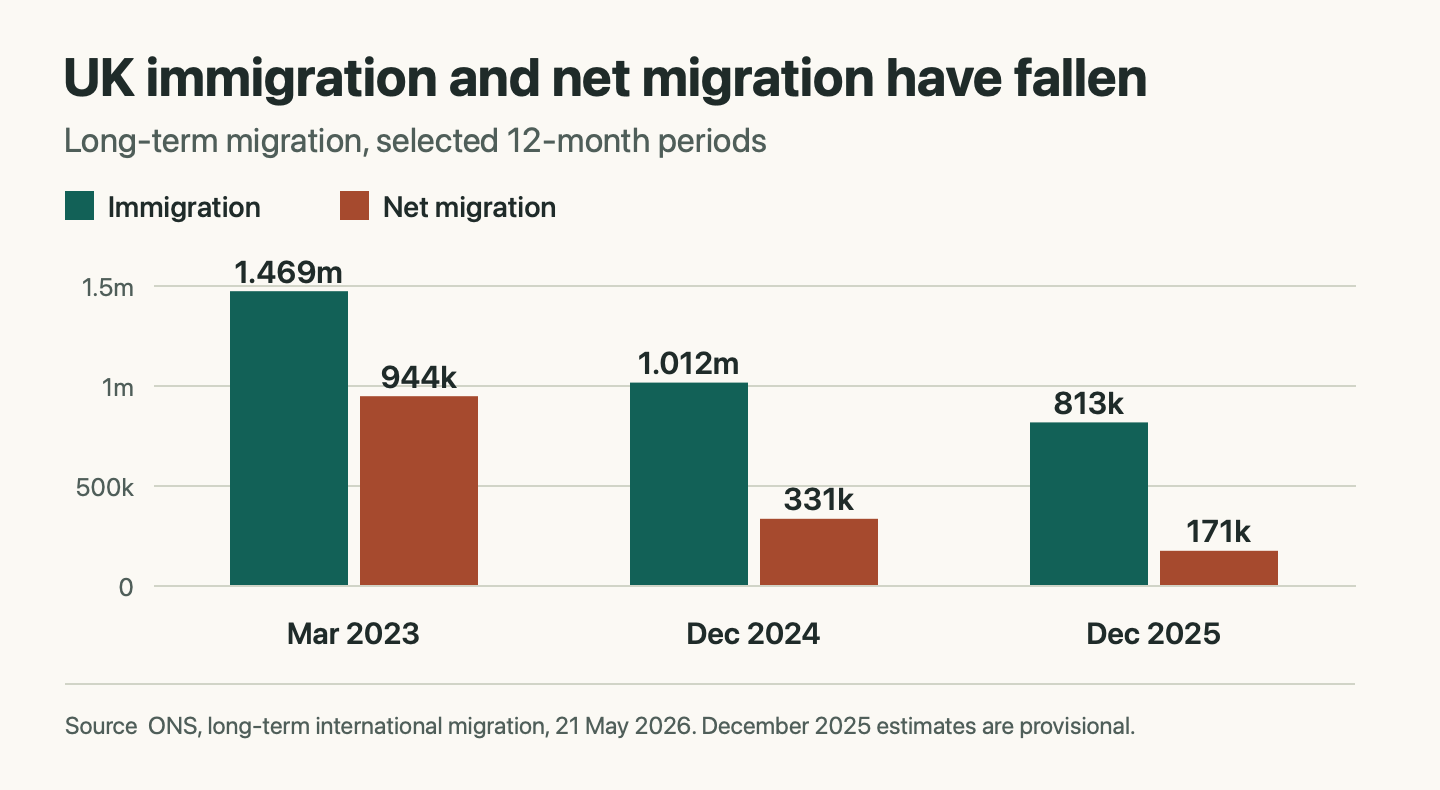
That does pose a problem for the right wing in the United Kingdom, because so much of what they’ve been bleating on about for the past 10 or 15 years has been directly centred around the threat of migration. The so-called “Boris Wave” was going to overrun us and, before you knew it, you wouldn’t even be able to do a Morris Dance without being immediately incarcerated. British culture would be completely destroyed if you had to believe the right-wing commentariat.
Well, 642,000 people left the country long-term in 2025, including 278,000 non-EU+ nationals. Just over half of those 278,000 originally came on study-related visas. The migration cycle has turned out to be people coming and people leaving, as it always has been.
And despite what John 01628 on Twitter would have you believe, the OBR says net migration has been a significant driver of growth in the UK economy, and other studies have found that the drop in migration may now even be contributing to a fiscal shortfall.
Funny that, isn’t it?
That, of course, hasn’t stopped the right wing from having a full-on blind fannywobble whenever given the opportunity and an open mic. Now that net migration is dropping, we’re seeing the story change. “Oh, well, it’s because so many British people are leaving.”
Well, yes, some are. But 246,000 British nationals left in 2025 which was down from 257,000 the year before. Emigration fell overall. The main change was how many people came in - that being the problem we’ve been told to focus on all along.
The issue, though, is that even this Labour government is still desperately clutching onto immigration as a hot topic.
On 2 November Shabana Mahmood set out the government’s plans for “earned settlement”, or indefinite leave to remain. It’s a nice little tiered system that’s been cobbled together.
Earn £125,141 a year for three years, or three of the last four, and you could qualify in three years for indefinite leave to remain.
Earn £50,271 for three of the previous five years and you could qualify in five, as could some public service workers.
For everyone on the standard qualifying route? Ten years. Good Lord. Some people who’ve accessed specified public funds or breached immigration rules could face 20. The detailed rules are still to come.
There’s something I find sickening about using someone’s salary as a measure of what they contribute. Earn £150,000 managing a hedge fund? Great. Wonderful. Hit the other requirements and you could settle in three years. A care worker can spend every shift doing work we’d be utterly fucked without and still come nowhere near the salary threshold for the same route.
Meanwhile, the person who comes here on a Seasonal Worker visa to pick our cabbages and turnips has no route to settlement through that visa at all. The migrant who comes here and toils away in our fields is the one actually putting food on our table.
And I do wonder how much of this conversation is driven by advisers looking at Twitter, looking at this thoroughly online bunch of people, some of whom we can’t even be sure are human beings and not bots on a Russian influence farm.
Yes, I agree, you need to have a finger on the pulse of what’s going on in the country, but surely you also need to be able to make a decision yourself, based on some actual data, facts and figures. We’re dealing with feelings a lot of the time, and largely, it seems, with Nigel Farage’s feelings.
We see the same thing happening with welfare.
It’s been a very handy punching bag for the Daily Mail, the Sun and the Daily Express for many a year. “Benefits Britain” and all the rest of it. Those headlines have been doing the rounds since what feels like time immemorial - but, crucially, they’re just that: headlines.
So let’s have a look at the actual bill.
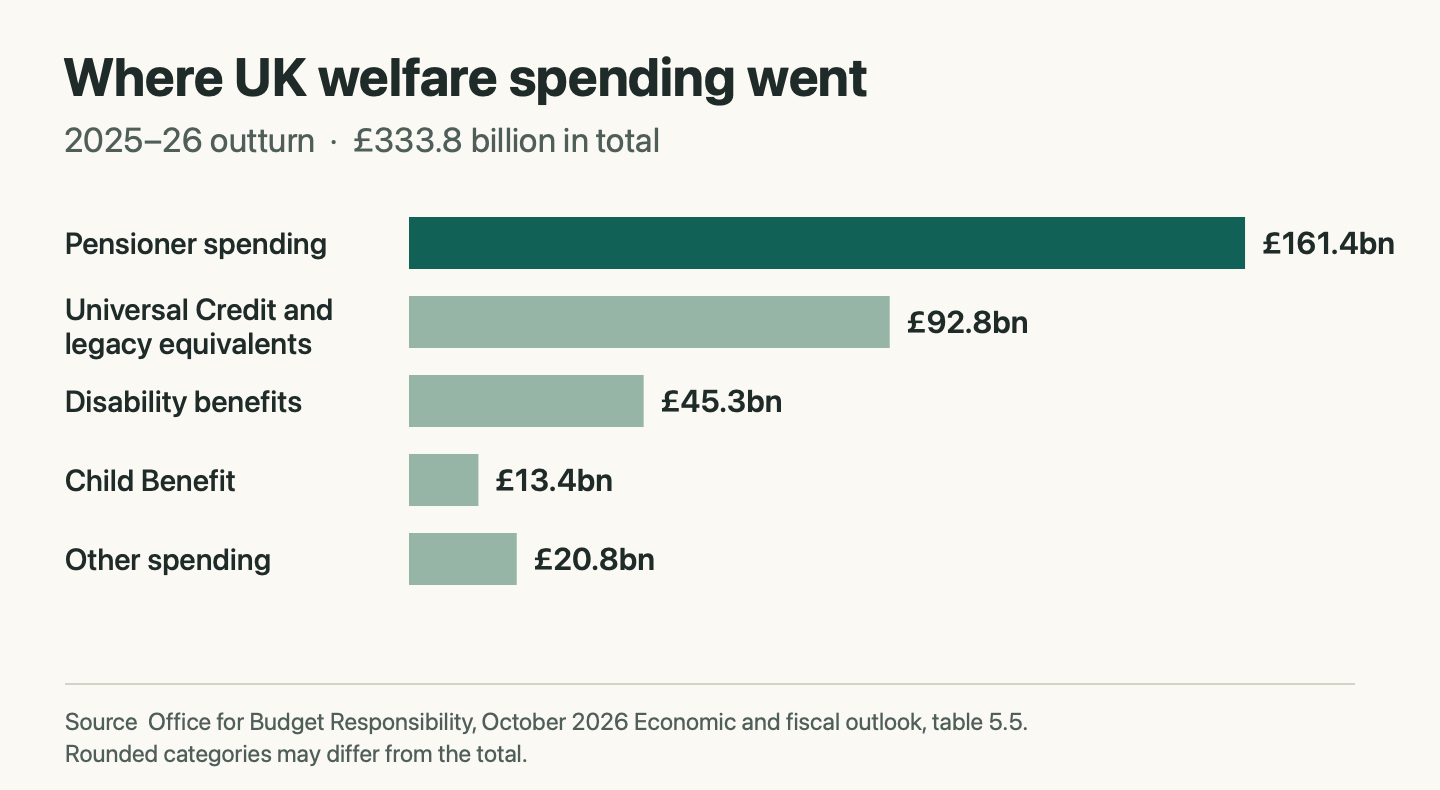
The OBR puts UK welfare spending in 2025–26 at £333.8 billion. Of that, £161.4 billion was pensioner spending, so just under half. £92.8 billion went on Universal Credit and its legacy equivalents, £45.3 billion on disability benefits, £13.4 billion on Child Benefit and £20.8 billion on everything else.
There’s this assumption that is bandied about that most of our money goes on keeping people at home so they don’t need to work. The biggest share goes to pensioners, and rightly so, for a very good reason.
In the early 2000s we had rampant pensioner poverty. In 2001–02, about one in four pensioners were in relative poverty after housing costs. That’s unfair for any group, but it’s especially grim for people who have largely left the workforce and can’t just pull themselves up by their bootstraps and go out and earn a couple of quid. It was right that we looked after them, and we do have a very big bill for it.
It’s also right that we help people with the extra costs of being disabled - which is exactly what Personal Independence Payment is for. You can get it in work or out of work. And yes, health-related welfare spending has gone up significantly - it was around 2% of GDP for decades up to 2019–20, rose to 2.8% in 2025–26, and the OBR expects it to reach 3.2% by 2031–32.
The question, though, is why is this happening?
There’s a particularly strong focus at the moment on young people. On 13 November the Guardian reported that Alan Milburn’s forthcoming review would propose replacing the health element of Universal Credit for under-25s with work and training support, and replacing ongoing PIP for some with access to a local fund for specific costs.
The Guardian also puts spending on young people, excluding children, at about 2.5% of the welfare bill. Look at how much airtime goes to the idea that twenty-somethings are bleeding the country dry. You’d think they’d be rather further up the spreadsheet.
But we have to ask ourselves what the last few years have been like for people who are 20 or 25 now. They spent some of their most formative years during Covid. Milburn’s interim report describes the struggle to get mental health support and find routes into work. I don’t know how much of the rise in claims you can put down to Covid, but you can’t spend years giving people little to no support and then go, “Ooh, something doesn’t look quite right here.”
Milburn himself told the Guardian he hadn’t met a single young person who wanted to be out of education, employment or training. They wanted independence and a chance to earn their own money. So yes, something doesn’t look quite right. You can’t just point at a group of twenty-somethings and go, “Well, yeah, no, you lot are a bit of a problem for us,” and expect them to just take it.
Where’s the mental health support? Where’s the social support? Where are the actual opportunities?
Young people were thrown in the bin by the Tories during austerity, and it feels like Labour is in danger of doing the same thing, and so much of it mirrors the rhetoric found on social media and in grubby tabloids, with so much of it boiling down to “laziness” and “entitlement.”
“Lazy” and “entitled” are things you call people on the internet when you don’t particularly care what the answer is. What irritates me even more is that when you talk about taking away disability benefits, you’re talking about the people who care for them as well. What happens to the parents who’ve been looking after a disabled child for years and years? Where does that leave them?
It’s all genuinely a bit dystopian. On immigration, arrivals have fallen sharply and the government is still tightening the rules. On welfare, health-related spending really has gone up, and somehow we’ve ended up talking about twenty-somethings who supposedly can’t be bothered. One debate barely registers the change in the numbers. The other takes a real change and reaches for the easiest people to blame.
The people we hear from online or in the tabloids have their own agendas. Sometimes it’s a racist one. Sometimes they’re just being a bit of a populist. Either way, social media tells us what social media thinks. It can tell you what got a reaction from the people who saw it. That’s a hell of a narrow sample to govern by.
Now, obviously, I’ve benefited a great deal from social media. I got my start there. I also know what gets people clicking. Anger does. Fear does. A spreadsheet showing net migration down by 82% from its peak is, regrettably, less likely to start a 4,000-post pile-on. The algorithm counts the clicks and the replies. When politicians read that as public opinion, the algorithm gets a say in who can settle here and who gets help when they’re struggling.
And I don’t know about you, but I certainly don’t remember voting for the fucking thing.
I’d genuinely love to know what you think. On that note, I’m closing my computer and going for a nice, freezing walk.
Have a fantastic Sunday.
My son is 23 he has a Masters degree in Economics and finance he left university and applied for 400+ jobs, he got nothing back, nada, zilch. His CV was checked by a professional HR person we know and was in good order.
He first got a casual job delivering parcels and in April this year landed a local job as a trainee service manager.
It's a small family run firm but its work is nationwide and he has flourished, he's not a number. He has earnt his bosses respect.
His fiancée moved up she has a Masters degree and she has landed a job working in a pub. She has an interview tomorrow for a position in sales, its a job she really wants in a field she loves, so we've all got our fingers crossed.
Job hunting isn't easy, getting past the AI application sift seems to be nigh on impossible.
My son was given a chance, which he grabbed with both hands and ran with it.
Bosses give these young people a chance, you may pleasantly surprised.
Morning Bear.
All these connived, confusing and downright inhuman policies are based on one requirement. To other then do harm to specific groups of human beings.
The moral panic is just a means of justifying the visceral desire to hurt people who belong to one group or another that is the subject of common or garden prejudice.
The likes of Mahmood and Milburn are ruthlessly exploiting the trend to secure power for the longer term and fuck the consequences to individuals and society.