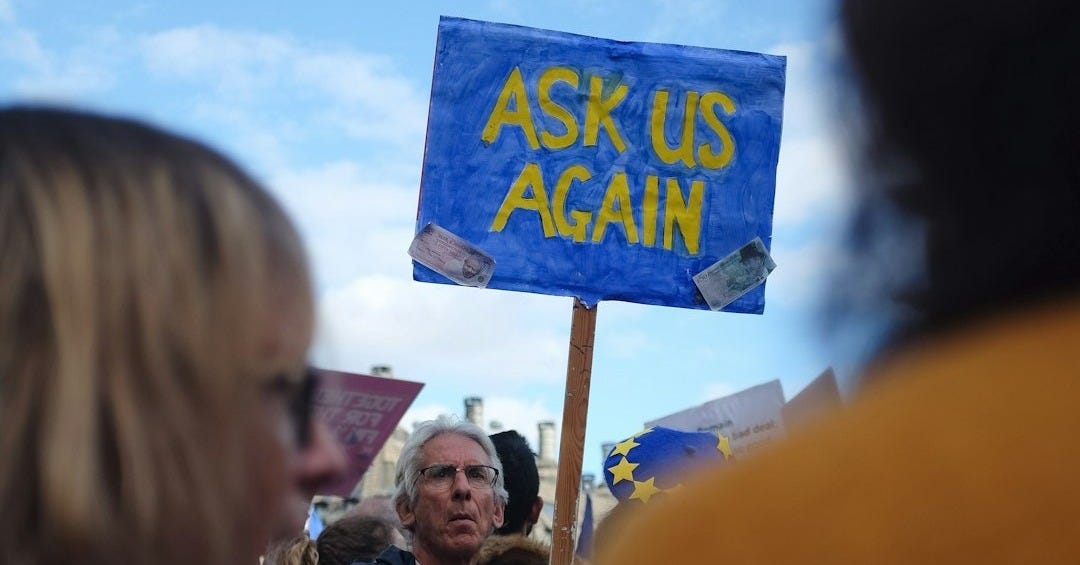
The Brexit Boil Is Finally Bursting
After years of silence, polling shifts, economic stagnation and Farage’s latest windfall have dragged Brexit back into the centre of British politics.

Ten years ago around this time of the year, I was still living in South Africa. My concerns at the time were mostly around whether we would be able to cook dinner on the stove that evening, or whether it would be another braai because the power utility would shit the bed again around the time I got home from work.
While pretty interested in international politics, the UK’s referendum on European Union membership largely felt like one of those bizarre bits of wealthy-country political theatre that happened somewhere else. Important, certainly. Interesting, absolutely. But distant.
I remember sitting in Johannesburg watching parts of the campaign unfold with a kind of fascinated disbelief. Even from the outside, it all felt remarkably unserious for something carrying such enormous consequences. A country deciding whether to fundamentally redraw its economic and political future through a campaign involving red buses, Nigel Farage standing in front of anti-migrant posters, Boris Johnson pretending to be Winston Churchill with shitter hair, and an absolutely staggering amount of bullshit.
At the time, though, I still didn’t fully appreciate what was happening - but now I really, really do. I’ve been living in the UK for the past ten years now, and despite what quite a few voices on the hard-right might want me to believe, it is my home.
I built my career here, made a fantastic group of friends and have sat through enough rail delays, council consultations, passive aggressive neighbourhood WhatsApp chats and stilted conversations about the weather to qualify as culturally British at this point. I am also writing parts of this at 05:30 in the morning because our tiny fur daemon decided breakfast was an urgent constitutional matter, which I suspect fully completes the citizenship process.
And speaking very frankly, one of the weirdest, most bizarre thing about living in this country, especially over the past several years, has been the absolutely steadfast refusal to discuss Brexit honestly.
Not among normal actual human beings, mind you - ordinary people absolutely do discuss it, and do so nearly constantly, usually in the form of:
“Everything feels more expensive.”
“Why is nothing working properly anymore?”
“Why can’t we hire staff?”
“Why is growth so incredibly lacklustre?”
“Why does everything feel so much smaller, meaner, poorer and harder?”
The hesitance to speak about Brexit, and its impacts, does not come from people on the street, it comes from, proverbially speaking, inside the house, inside politics. And particularly Labour politics as that.
Ever since the electoral trauma of 2019, the Labour Party has behaved like Brexit is a cursed object that should, at all times, be confined to the basement. You don’t touch it, you don’t think about it, you don’t even mention it. Under on circumstances do you make eye contact with it lest Nigel Farage materialises behind you like Bloody Mary in a Wetherspoons loo.
The strategy, as it were, seems to be obvious enough - Labour leadership became utterly terrified that any serious talk about Brexit in any way or form would instantly trigger another Red Wall collapse, so instead, the party has settled on basically nervously backing out of the room the moment there is any mention of Brexit while avoiding any sudden movements.
They held onto their very own version of Theresa May’s “Brexit Means Brexit” in the form of “Make Brexit Work”, and as with all flat, slightly patronising three-word slogans, it really made no sense.
“Make Brexit Work” was never really any sort of coherent political project - it was, above all else, a holding pattern. It was a way of the party leadership saying:
“Yes, fine, we know this is all going badly tits up, but could everybody please stop fucking talking about it until after the next election, please and thank you.”
The issue with this, unfortunately, is that reality has this irritating tendency to continue existing regardless of just how hard a political strategist tells you to shove your damned fingers in your ears. For years now, the United Kingdom has been in this truly strange state of collective dishonesty where people are expected to experience the consequences of Brexit while at the same time, having to pretend it’s somehow impolite to mention it directly.
You see it constantly.
Businesses complaining about export barriers and trade friction, but politicians refusing to connect the dots too loudly.
NHS staffing shortages worsening while everybody tiptoes delicately around the fact that freedom of movement ending had catastrophic consequences.
Economic stagnation becoming the constant refrain of British life while politicians insist the real priority is to “look forward, not back.”
I am convinced this has done immense psychological damage to the British body politic, and nowhere more so than within Labour itself, because when political parties refuse to discuss something huge and obvious, the pressure does not disappear. It festers. And we are now watching that Brexit-shaped boil finally burst.
The timing makes sense as well - Labour’s current internal meltdown has collided with what has been a pretty dramatic shift in public opinion when it comes to the EU. YouGov/Best For Britain polling last month show that 53% want a full rejoin option when it comes to the EU with 61% of respondents wanting an overall closer relationship, even if it’s not a full rejoin of the customs union - with even 55% of Reform UK voters wanting the same.
Another poll that was conducted by Survation for LabourList found, to absolutely no one’s shock, that 87% of Labour members support rejoining the EU outright, with 72% strongly supporting it. Sixty-five percent of the respondents want Labour to commit to rejoining the EU as part of its next general election manifesto.
Despite what Lisa Nandy was saying yesterday about the EU being a “world away”, it is becoming increasingly clear that improving our relationship with, and even rejoining our closest neighbour is not a fringe position anymore. The country is shouting at Labour saying “PLEASE FOR THE LOVE OF GOD TALK ABOUT THE THING!”
And to be fair to Labour, some of their most prominent figures have. Wes Streeting has rightly called Brexit “catastrophic”, Andy Burnham has openly said that he hopes the UK rejoins in his lifetime and Sadiq Khan has gone even further with an argument that Labour should eventually campaign explicitly on rejoining.
The problem is that every single time a dissenting voice emerges, the same pushback follows: “this is not what people want”.
Which is also exactly the point at which this really does become politically fascinating to me, because while I think that Labour’s refusal to engage with honestly with Brexit has probably strengthened Reform UK instead of weakening it.
Yesterday, following Nandy’s somewhat patronising comments, I posted on BlueSky that there is, perhaps, the appetite out there to have a chat about Brexit, and the responses I got were enlightening to say the least.
Sarah Murphy commented that:
Which is exactly the point. The problem isn’t just the consequences of Brexit itself, but the enforced unreality around it.
Graham Davis, argued that Farage’s political career should be permanently tied to the consequences of Brexit itself:
For years and years now, the two main parties in the UK have treated Brexit and its consequences a bit like it was a natural disaster that simply descended from the heavens, instead of a political project that was sold, designed and championed by specific people who are still very much in public life.
Nigel Farage himself admitted this week that the £5 million he received from billionaire Christopher Harborne was effectively a reward for Brexit campaigning.
A reward. For Brexit campaigning. There is something genuinely grotesque about that sentence.
Ordinary people, like you and me, got higher costs, labour shortages, weaker growth and a decade of economic stagnation, while the guy who actually drove the whole damned thing got rewarded with billionaire donors and suspiciously timed cash property purchases.
Which is something that people notice - and is a genuine golden opportunity for Labour. Start openly discussing the impacts of Brexit and start explicitly laying it at the feet of Farage and his mates. To finally putting him in a corner where he can’t weasel his way out with bleats of “but this is not the Brexit we voted for.”
Normal people may not always sit around discussing customs unions or frameworks over brunch, but you can be absolutely sure they’ll mention that their lives have got worse while the architects of Brexit seem to be doing £5m donations levels of fine.
There is another aspect of this that’s immensely important - over the past decade the country has demographically shifted in very significant ways. Will, another follower on BlueSky pointed out that:
And he’s probably right - and not in the sense that older Leave voters are villains, but because electorates, countries and political identities evolve, and what was true in 2016 at a rate of 52 to 48 percent, is almost certainly not true in 2026.
In Scotland, meanwhile, people have never stopped being pissed off, with Barbara noting that:
Neither the resentment felt by members of the union, nor the economic consequences have disappeared - and neither have any of the political contradictions. They were simply shoved into the back of the cupboard because there were too many politicians who became convinced that the only way to survive Brexit politically was to never, ever discuss it ever again.
In doing this, they have created a situation in which the pleas to not relitigate have inadvertently caused us to be trapped in a Brexit sequel anyway, which is the thing that Labour doesn’t seem to fully grasp. Silence, especially an imposed years long one, is not nearly the same thing as resolution.
You cannot spend years refusing to discuss one of the biggest political and economic ruptures in modern British history and then act surprised when the issue eventually bursts violently back through the floorboards in the middle of a leadership crisis.
Especially when the public has quite clearly moved ahead of the political class itself.
The taboo is breaking now because reality finally became too large to step around politely.
And thank Christ for that, honestly, because whether Britain eventually rejoins the EU or not, the current situation where politicians are allowed to discuss “dynamic alignment”, “sector-specific convergence” and “enhanced regulatory cooperation” while pretending nobody is talking about Europe anymore is just absurd.
The country deserves a more honest conversation than this, even if that conversation turns out to be messy, politically dangerous and deeply uncomfortable for the Labour Party.
Frankly, after ten years of this shit, we’ve earned one.


My bugbear (ha ha) is that the Brexit ref was held as an 'advisory' ref... and then was treated as a mandate.
Had it been a proper mandate ref, it wouldn't have passed because the yes/no split wasn't large enough.
Even invisible elephants in the room produce a shitload of ordure. People cannot hold their noses forever - not even the Labour Party.