Deep Dive: Palantir Has an End Date
Years of pressure got us an end date. Now we have to make it stick.

On Monday, the 16th of November, there was some good news, or rather I should say, even more good news.
And I have to say here, I really quite like writing about the good things that happen in the world - whether that’s the battering the Republican Party took in the midterms (we’ve just heard that Alaska has also gone to the Democrats), or whether it’s the fact that Reform UK is now in the teens in one poll, and their abject descent into further irrelevance is becoming faster and faster. There is a lot to celebrate.
Going back to the 16th of November though, the government has now said that the Palantir contract will only run until March 2029. It could have run until 2031. The government could also have ended it in 2027, and there are some practicalities around that one.
That’s what I wanted to discuss in this piece today.
And this is going to be a slightly longer piece because I think the story of Palantir is a fascinating one, and the consequences of this decision are also really important because, while again, definitely good news, I would say that it’s a bit more of a mixed bag than simply telling another member of the tech oligarchy to go fuck themselves.
What is Palantir?
So, for anyone uninitiated, Palantir is a US-based software company. It sells platforms for joining up bits and pieces of data held across many different systems so that the organisations involved can act on it in one place. Some of its products include things like Gotham, which was built for the intelligence and defence community, and Foundry, a system which I am myself actually familiar with, as I did work with it in the NHS. It’s largely for commercial and public sector use. And then there’s AIP, a newer layer for using AI models on customers’ own data.
It was founded by Peter Thiel and Alex Karp with early backing from the CIA’s venture arm, In-Q-Tel. Karp is still the chief executive. They chose the name Palantir as a nod to J.R.R. Tolkien’s palantíri. If you’ve seen the films, you’ll know the one. Saruman the White is in his tower with the nice little glowy black orb which he uses to see places. (That, to me, is a bit on the nose - and while I would usually applaud a nice nerdy reference, I’m a little less keen on this one.)
In terms of who uses it, there’s the US military and intelligence agencies and, controversially, US immigration enforcement. Banks use it, manufacturers use it and, as in the UK, health systems use it. In the UK, it also has work with the Ministry of Defence, police forces and the Financial Conduct Authority, as reported by Peter Geoghegan with Democracy For Sale.
A bit about Peter Thiel
When talking about Palantir, you also have to talk about Peter Thiel who is, as mentioned, one of the founders. Thiel, in his own right, has a bunch of dodginess around him himself, with one of the earliest bits of dodginess being that Thiel confirmed he spent about $10 million on litigation against Gawker, including backing Hulk Hogan’s invasion-of-privacy case. That case helped drive the site out of business. Thiel traced his motive back to a 2007 Gawker post that outed him personally. He argued that the threat of ruinous litigation was needed to protect people against what he called press intimidation.
Because obviously nothing says freedom of speech like billionaires going after the press.
But I digress.

In a 2009 essay for Cato Unbound he wrote that he no longer believed freedom and democracy were compatible. In the same essay, he argued that the extension of the vote to women, alongside the growth of welfare, had made it harder for libertarians to get their way through democratic politics. And I keep thinking of that old Maya Angelou line that if someone shows you who they are, believe them the first time.
“I remain committed to the faith of my teenage years: to authentic human freedom as a precondition for the highest good. I stand against confiscatory taxes, totalitarian collectives, and the ideology of the inevitability of the death of every individual. For all these reasons, I still call myself “libertarian.”
But I must confess that over the last two decades, I have changed radically on the question of how to achieve these goals. Most importantly, I no longer believe that freedom and democracy are compatible.”
Peter Thiel, The Education of a Libertarian, 13 April 2009
He was also one of the first tech oligarchs to be at Trump’s side. He spoke at the 2016 Republican National Convention, backed Trump and joined his transition team. It’s fair to say that being there early served him well in the decade that followed. He’s still close to the Trump world.
Trump wasn’t his only political project, though. JD Vance is a protégé. Thiel gave $15 million to a super PAC backing Vance’s 2022 Senate campaign, and he’s widely seen as Vance’s mentor. Some writers describe this distrust of democratic institutions and enthusiasm for governance by elites as techno-authoritarianism - something written about at length and with great insight by Carole Cadwalladr in her brilliant Substack, How to Survive the Broligarchy.
And then, most pertinently, there’s what Thiel said at the Oxford Union in January 2023. While Palantir was bidding for an NHS data contract, he described the British attachment to the NHS as “Stockholm syndrome” and argued for bringing market forces into it. Palantir said he was speaking in a personal capacity.
I’d find that distinction a bit more reassuring if Palantir hadn’t used its own X account this April to publish a 22-point summary of The Technological Republic, the book its CEO Alex Karp co-wrote with Nicholas Zamiska. It calls for Silicon Valley to help build AI weapons and takes aim at pluralism. I’d call that a technofascist screed. The company apparently thought it was worth putting its name to.

All of this can’t help but give the impression of someone who’s drunk on his own power, and someone who, for the most part, should probably not be allowed within a mile of something as sensitive as health data.
What did the NHS get out of it?
Going to Palantir itself, it’s absolutely worth a closer look at the controversies around the company and the contracts it holds.
One of the biggest concerns around the NHS contract was vendor lock-in. The fear, right from the start, was that one supplier could become so embedded that replacing it gets harder and harder as time goes on.
Another issue with the NHS rollout is that the Health and Social Care Committee noted that the evidence was, to put it mildly, less than ideal. Many of the reported gains compare performance before and after rollout, without showing that the tool caused them, and the Office for Statistics Regulation challenged the way NHS England presented those figures. The evidence didn’t establish that the platform was directly responsible for the improvements.
On top of that, the Financial Times analysis found that the gains were concentrated in a few trusts. The Register reported on Foxglove’s freedom of information work, which found that Chelsea and Westminster accounted for 84% of the fall in outpatient waiting lists in that analysis. LBC, on their side, found that half of the 16 trusts using Palantir’s outpatient tool saw their backlogs rise between the national rollout in April 2024 and June 2026, while England’s waiting list fell by about 4%.
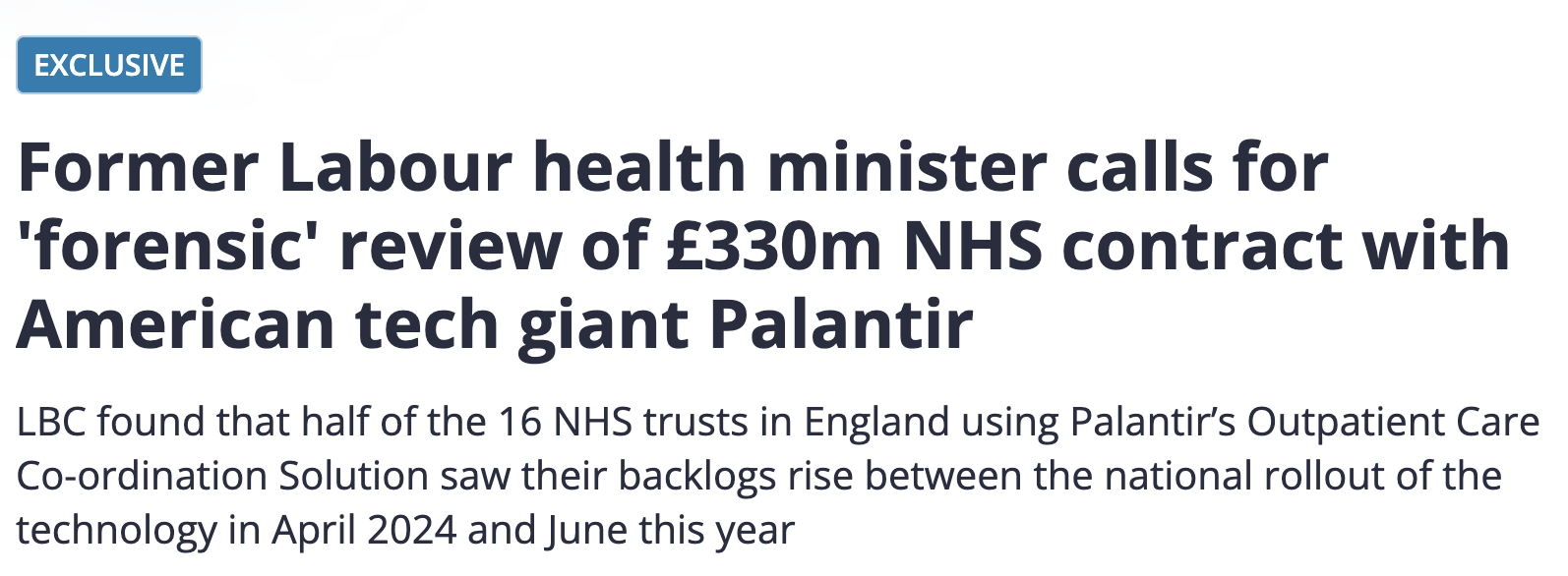
That alone is a massive statistical discrepancy, and The Department of Health pointed out to LBC that the tool flags patients who might be ready to come off a list, while new patients can still join it. So a growing backlog on its own can’t tell you whether the tool did its job either.
Another real concern, and one that’s probably harder to quantify, is data access.
The Financial Times reported in May 2026 that NHS England had allowed selected staff from Palantir and other contractors administrator access to identifiable patient data in part of the platform citing an internal briefing note. NHS England response was that there were strict policies and regular audits, and Palantir said it acts only as a data processor, under NHS instructions. The contract bars Palantir from commercialising NHS data, even when it’s anonymised.
The issue with that is that it’s very hard for outsiders to check compliance. The National Data Guardian asked NHS England for clarification after the reporting came out. And that problem applies to other providers too. Moving the contract to another company still leaves you with the job of checking who can see what and what they can do with it.
What else Palantir has been doing
Looking beyond the NHS and some of the controversies there, I think it’s important to look at the broader world Palantir works in. In 2011, leaked emails indicated that staff at Palantir, HBGary Federal and Berico helped prepare a plan against WikiLeaks and its supporters. Palantir’s chief executive apologised at the time and said the company had cut ties with HBGary Federal.
There was also a secretive predictive policing programme in New Orleans that began in 2012. Palantir supplied software to a police programme that used things like gang links, criminal histories and social media to try to predict who might commit or suffer violence.
And if that feels a bit like Minority Report, well, that’s because it is - just without the precogs or Tom Cruise sprinting to the rescue.
It was set up as a philanthropic arrangement, which let it bypass public procurement and escape public notice for years - which makes me question even more why it was allowed to happen.
In addition to this, Palantir has been intimately involved with ICE, the US immigration enforcement agency. In 2025 it was awarded a roughly $30 million contract to build ImmigrationOS. The aims set out for the project included streamlining how ICE selects people for apprehension and tracking people who report that they’re leaving the country voluntarily.
Now, while all this is in the peri-dystopian United States, in the UK, there’s a fair bit of controversy around the company as well, with even its inception looking dodgy.
The relationship with the health service in particular started with a £1 deal during COVID, which rapidly expanded into a £23 million contract by December 2020, with no fresh open competition. I think that’s completely unacceptable for a contract that large. Under normal circumstances, I can guarantee you that any procurement specialist would be reaching for every tool they had to check whether that was the right deal. There’s a difference between getting something in the door in the middle of a pandemic and signing a two-year deal for it that December.
The terms of the COVID contracts also raised questions about whether the companies involved could profit from intellectual property generated by the work. The NHS said the companies couldn’t use patient data for their own purposes. The fact that there was any doubt about what the companies could get out of the work to begin with is deeply problematic.
On top of that, there was an £8 million deal with KPMG to promote the adoption of Palantir’s technology in the NHS. Democracy for Sale reported on that and on officials withholding details. There was also reporting that Palantir was very keen on getting into the Met Police with a proposed £50 million deal that Sadiq Khan blocked, and Palantir challenged the decision.
How Palantir got into the NHS
Now, I think it’s worth going through how they got into the NHS in the first place. As I’ve already mentioned, it got going in March 2020, but there was a step before that. NHSX, which is now defunct, reportedly met Palantir in San Francisco for a software demonstration a few months before COVID hit.
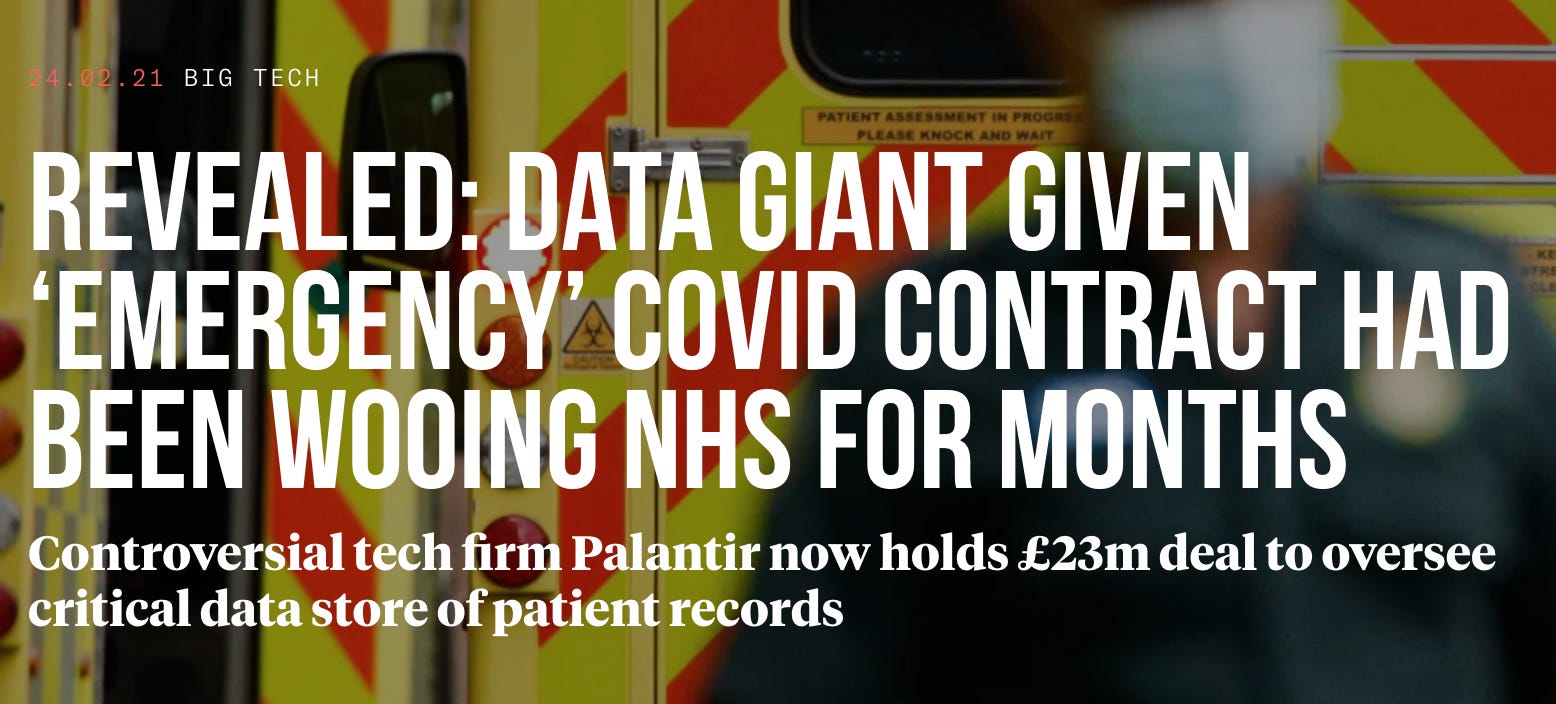
By March 2020, COVID had hit and Palantir was doing work on the COVID-19 data store for the nominal sum of £1. That was alongside Google, Microsoft and Faculty, among others. There was no competition for that emergency deal, and it gave Palantir a foot in the door. By July 2020 there was a new deal worth about £1 million. And by December 2020, as mentioned already, a two-year, £23 million contract was signed.
In 2021, openDemocracy and Foxglove launched a legal challenge. In this challenge they argued that the deal went beyond the emergencies it had originally been set up to deal with. NHS England committed to public consultation on any long-term plans for the COVID data store. In 2023, NHS England then put a transition contract in place, which was there to allow it to move over to another provider if it needed to. In essence, it became a bridge to the national deal.
On 21 November 2023, NHS England announced that it had awarded the Federated Data Platform contract to a group led by Palantir, with Accenture, PwC, NECS and Carnall Farrar. The forecast was up to £330 million over seven years.
This is the contract we’re talking about now. It formally began in March 2024, and there was a lot of pushback. The Financial Times data access report came out in May this year, the committee and statistics watchdog raised concerns over the summer of 2026, and that leads us to 16 November, when the government confirmed the contract will end in March 2029.
Back to the good news
So, going back to the good-news side of things. I think for me the biggest thing is that there is now a firm end date for this deal. Only three years, to March 2027, were committed at the outset. The NHS could extend by two years, then by two single years, to a maximum of March 2031. That was how the original contract was set up. Ministers have now taken the two-year extension and said they’ll stop there.
There will now be a competition, which basically means that Palantir can’t depend on getting the contract by virtue of being the current provider. Formal procurement is set to start in the second half of 2027, and it’s meant to be open to UK and international providers, including small firms, which is a very big positive.
James Frith, called the decision “a bridge, not the destination”. The government plans to move to a new platform when the contract ends. Frith said there are exit and transition provisions and made the distinction between intellectual property funded by the NHS and the supplier’s own existing intellectual property. Palantir has told ministers that the NHS has the rights and support it needs to change suppliers. So, all very sensible.
The safeguards decided at the beginning stay in place. Palantir can’t commercialise NHS data, even if it’s anonymised, or use it to develop its own products. I still have reservations about how well the public will be able to see those safeguards being enforced, but having them very clearly in writing and agreed does help to an extent with accountability.
The biggest win to take away from this news however is that the scrutiny worked. The Health and Social Care Committee had urged ministers to use the earlier break clause and look for an alternative. And this end date comes on the back of sustained pressure from MPs, staff, campaigners and brilliant investigative journalists.
That’s a point worth stressing in terms of public accountability and there’s a helluva lot to be very positive about here.
The caveats
Now, time to be the Bear-of-Bad-News.
Even with acknowledging all the good news, there are limitations. What I think a lot of campaigners would have loved to see is a 2027 exit. Ministers declined to take the break the committee recommended, citing continuity of care and the benefits they say the platform is already delivering. Funding stays at the current annual rate for the extension. So Palantir stays on the platform until March 2029.
An important thing to note is that Palantir can bid again. A retender is, unfortunately, no ban. If Palantir were to win it, the end date would mean very little in practice.
The other point that’s worth stressing is that the timeline for the procurement is tight. Very tight.
Getting the contract to end in 2027 and having a replacement in place would, I think, have been exceptionally difficult, and this is coming from my own experience, both working within the NHS and dealing with procurement there, as well as now working with NHS procurement from the other side. The 2029 timeline in this sense, is pragmatic.
Engagement starts in January 2027, while formal procurement starts in the second half of the year. Frith said the whole process, from engagement to completion, should take about 18 months. On that estimate, you get to around the middle of 2028, which gives the NHS months to move over before the 2029 deadline. Frith put the number of trusts that had activated the platform at 142, a figure challenged in the Commons. Whatever the final number, there’s a lot to move, and if that timetable slips there’s a real risk that continuity of care comes up again.
Dame Chi Onwurah did argue in the Commons that a break clause you can’t use because of continuity of care is effectively lock-in. And there’s every possibility that continuity of care could be cited again if the timetable slips. It’s the same argument, and it applies every bit as much in 2029 if the NHS hasn’t got a replacement it can actually move to.
“I am extremely disappointed by his decision with regard to the Palantir contract. Palantir exhibits three of the four barriers to effective digital transformation that my Committee identified in its recent report, “Rewiring the state”: hype, vendor lock-in, and a lack of digital sovereignty. If a break clause cannot be exercised because of continuity of care, it is not a break clause; it is a lock-in.”
Dame Chi Onwurah, Hansard, 16 November 2026
And the other consideration is very practical. What does that migration actually look like? The minister says it’s possible in principle. Onwurah asked how rival suppliers would get equal access to the platform, its existing architecture and its users. The minister didn’t set out how that would work in his answer. And this is quite important because if Palantir tenders again, it has this huge advantage. They know the architecture. They know the users. They have those relationships. What’s going to be done to give other bidders that same benefit?
The NHS still needs a way to join up its data
One of the biggest points worth making is that, while I disagree vehemently with the fact that Palantir was involved in the first place, the idea of a federated data platform is an important one. The NHS, as structured, consists of hundreds of trusts, primary care networks and a whole range of providers, all of whom have their own data - and there absolutely does need to be a way for the right bits of that data to be shared between those organisations.
When you think of someone who’s under a social care plan or who’s in hospital, there are so many people involved in that person’s treatment and care. Having the ability for those people to see the information they need to do their jobs, where appropriate, is becoming increasingly important. The actual concept of a federated data platform, and of having standardised data and a way to understand and work with it, is incredibly important and is one of the most important factors of having a truly integrated healthcare system.
Palantir does need to get out. I’ve never been a fan of them. I think they’re a very grubby little operation. But. There still needs to be a solution in place. I think there’s an opportunity for a couple of really good companies in the UK to get their stuff together ahead of the next procurement. What I’m hoping, genuinely hoping, to see is a viable local alternative that’s accountable, that’s transparent and that can do the work.
Again, the good news is genuine. The deadline helps, and getting a public, transparent competition on the record helps. The pressure moved the government.
Those are all really, really good things. And the caveats are genuine too. Palantir stays until 2029, it’s free to bid again on a tight timetable, and there’s still a gap in the evidence about what the platform actually achieved. The underlying problem is still there. NHS data is held in separate systems across trusts and integrated care systems, and that will keep being a problem until it’s sorted.
Now, switching supplier doesn’t actually unify the data by itself. That’s going to take a lot more. It’s going to take standards and governance and local buy-in and funding and skills, whoever supplies the software. Having worked in this area for many years now, I know that’s a massive challenge. And I think this is where I welcome the date, but I want to see that the pressure stays on the people involved. I want the new way of doing things to be transparent, and I want it to work for the people who are going to depend on it.
A special note should be made in this piece to all the people who have campaigned, reported on and investigated Palantir - in particular Lucas Amin and Peter Geoghegan at Democracy for Sale, Carole Cadwalladr and the team at The Nerve, Crofton Black at the Bureau of Investigative Journalism and the teams at OpenDemocracy and Foxglove who started their scrutiny all the way back in 2020.
A huge thank you also to Dr Julia Grace Patterson💙 from Call to Action, MedConfidential, Medact, Just Treatment, Keep our NHS Public and all the patients, service users, NHS staff and campaigners who were relentless in asking awkward questions when many others would have stopped far earlier.
This is from Robert Reich's Substack in June 2025:
Brotech
Draw a circle around all the assets in America now devoted to Artificial Intelligence.
Draw a second circle around all the assets devoted to the U.S. military.
A third around all assets being devoted to helping the Trump regime collect and compile personal information on millions of Americans.
And a fourth circle around the parts of Silicon Valley dedicated to turning the United States away from a democracy into a libertarian dictatorship led by tech bros.
Where do the four circles intersect?
At a corporation called Palantir Technologies and a man named Peter Thiel.
Keep asking the awkward questions everyone - with thanks.