

Yesterday, the unthinkable happened - and I’ll note that I’m talking about this as someone who hasn’t necessarily lived their whole life in the UK, but has lived here for the past decade, one of the first concepts I learned about when I arrived in the UK, politically that is, was the pensions triple lock1.
Introduced under the Cameron government, it guaranteed that pensions would rise by inflation, by wage growth, or by 2.5% each year.
What I realised, very quickly, is that the pensions triple lock was one of the do-not-touch subjects in politics, and even starting a conversation about it would result in quite some animus between anyone discussing it, even if they were discussing keeping it.
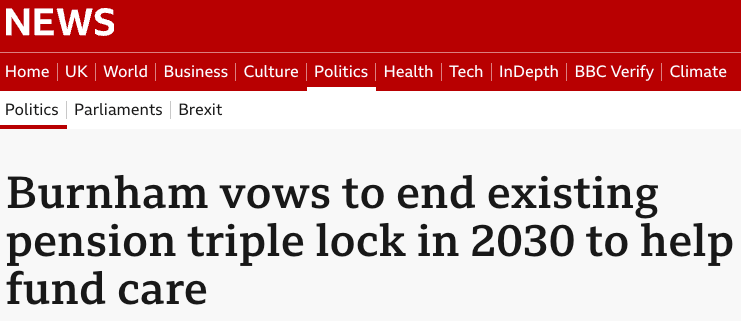
Yesterday it was confirmed by Andy Burnham in his first conference speech as Prime Minister that by 2030, the pensions triple lock would be no more. There will still be an increase of either 2.5% or inflation, so it’s not that pensions will get any lower, but the wage increase has fallen by the wayside.
That is a bold move, and I’ll be honest, it wasn’t one that I was expecting to actually materialise when I think of all the controversy that this has invited in the past.
I can also see how this is going to give a lot of ammunition to a lot of people to say Burnham is “stealing from pensioners”.
At the same time, however, according to Andy Burnham, the pensions triple lock is not being done away with to keep more money to pay for debt, but rather to pay for what Andy Burnham is calling a National Care Service.
Now, anyone who has read my work knows that I have, for a while, been talking about the demographic changes we’ve been seeing, because our tax base is going down significantly. As it stands, one in five people in the UK are over 65. And by 2040, that will be one in four.

The big thing for me, though, is that the trade-off of giving up the wage increase to fund a National Care Service, or at least partially fund a National Care Service (because I’m not 100% convinced that the savings made on the triple lock will fund the whole National Care Service), does seem to add at least a measure of fairness to the decision.
When I was working in the NHS, I worked specifically in community services, and care was, without a doubt, one of the biggest blockers we had. I would sit on a weekly call where we would discuss at least 20 to 30 patients in one local DGH alone with significant care needs who we could not safely discharge, because that care was either not available through the council, or they were unable to afford the care and we had to look for alternatives.
The availability of care, and the availability of rooms in care homes, was such a massive blocker that we ended up having patients staying in hospital for far longer than they needed to. Which, ultimately, was bad both for the patient and for the system, because if you can’t get a patient out of a bed and home, they will decondition and their ultimate outcomes will be even worse.
Being unable to discharge these patients home also creates a block at the front door, because we have patients coming into ED who are waiting to be admitted, but they can’t be admitted, because beds are blocked.
The best place for a recovering patient is at home, when it’s medically safe to do so, but medically safe and care safe are two different things.
Care is beyond the morally right thing to do, it’s a significant health need - and it’s a need that remains largely unaddressed in far too many communities across this country.
I care about this subject not only from a professional or demographic level, but also because I also know I’m going to get old one day as well - and I know that if I’m lucky enough to get to the age of 80, 85, 90, there is a really large possibility that I am going to need help. That I’m going to need care.
On a personal level, this decision does feel like someone is finally investing in at least parts of my future, because as a 40-year-old, I do feel like we, as a generation, have been largely left behind.
At 40 years old, I’m incredibly fortunate to own an apartment with my husband, but when I look at where my parents and their peers were at this age, I can’t help but feel that they were better off than we are today. They had full on houses! Something that my husband and I can only dream of upgrading to one day, if everything goes okay.
It’s a hard thing to reconcile that even though I’m doing a professional job, and my husband is a highly qualified clinician, we are just about getting by.
And I want to be very clear - this is not an us-versus-them situation, I’m not sharpening a pitchfork to have a go at Jan who lives downstairs from us2. None of this is coming from a place of bitterness, but sometimes I wake up and I do wish it was a bit easier, and that the future was a bit more secure.
As it stands, I have three jobs - I have my writing that I do, usually between around 05:00 and 08:00 in the morning. I have my main job, which I generally log on for from 08:30 to 17:30. I then have my third “job”, which I’ll do from 18:00 to around 20:003.
Whereas both my parents could get by with really just working a 9 to 5 job and raising kids on that income - something which, when we discussed having kids a few years ago, we realised there was no possibility of us being able to do.
My own pension and retirement age is many years away - and I will be honest, a part of me has made some peace with the fact that I'll likely never really be able to fully retire.
My long term plan is to, as I get older, reduce my main employment to one or two days a week by the time I reach sixty, and hope that by that time, my writing provides a significant enough income to support me as I'm getting older.
Saving is near impossible. I'm not saying our household isn't saving, but the amounts we're able to afford to invest and put away are in no way guaranteed to support us in our old age4.
So there is something here for me about looking at who your future pensioners are, and looking at who the people are who are currently paying taxes, and trying to reach a point of fairness in the situation.
As to the speech more broadly, there were really a couple of very positive things that Burnham mentioned. I think a lot of what was said, and a lot of how it was delivered, was very impressive, and Ian Dunt’s summary on the matter yesterday captures a lot of what I feel.

I think the National Care Service needs a lot of work. And controversially, I am going to say I hope that Labour does not win a stonking majority at the next general election, and that there is a need for them to go into a coalition with the Lib Dems and/or the Greens. Ed Davey has been a huge advocate for care for a long time, and Zack Polanski himself is a very good politician who, if focused in the right direction, can be very, very influential. Scotland, Wales and Northern Ireland need to be brought in as well in the early stages of planning and given a real voice in this project.
The EU pledges I’m treating with significantly more cynicism as it really does feel like we’ve been here before. It’s something that I would love to see happen, but out of everything that was said, it’s the thing I feel is most unrealistic.
The pledge to look at Electoral Reform - again, if it happens, it would be amazing.
There really was a helluva lot to like.
I think what has left me more hopeful is that it does feel like there’s an inkling of a plan. It feels like there is the possibility of real change. Does this mean that I will be voting Labour at this next general election?
As it stands, no.
Labour has to do a lot more than one speech to win back the trust that they lost with their actions in their first two years in power, but what I can say is that this speech was a first small step towards that.
If there is a solid plan by 2029, and if there is funding, and if there is the political will to make these changes, then I could be convinced. The approach that Labour has taken towards migrants over the past two years needs to immediately change direction, and they owe a very big apology to people on welfare, whom they have treated really poorly under Pat McFadden’s reforms. They do need to look at how they have approached the trans question. If they can do those things, or at least some of those things, I’m open to a conversation.
One speech, no matter how good, isn’t going to change everything. But it is a start.
The first life concept I learned about as I landed was the £3 Meal Deal, which for at least a few years was my main source of sustenance when we were just starting out.
My own pitchfork is aimed far more at billionaires, but that’s neither here nor there.
I have taken my midlife crisis very seriously and am now officially printing and painting Dungeons and Dragons Miniatures and Terrain. The nerdiness has truly taken over my whole life.
And before anyone goes there - yes, we have cut down on fancy coffees, takeaways and avocados.
In a former life I was a UK GP and for my sins also a Deputy Medical Director for some NHS organisations do like the Bear more than well versed in being on call both admitting patients and ‚finding‘ beds for new admissions.
It has been bonkers that these ‚ready for discharge‘ and therefore as well as the hospital was going to make, patients were stopping the more ill from getting in to where they needed to be, that is out off the ambulances, A&E wards and corridors.
I applaud Burnham for tackling this and going about it the right way.
He has a stonking majority in Parliament and Labour needs to deliver what is important to ordinary people.
This is one of these things.
Whilst at it he also promised to repair energy bills, the relation with Europe. Sorting boat crossings is even easier so I hope he tackles that one too.
Mediocrity and grey have too long been the choice of colour.
Ride on!
I fear the vast majority of people erroneously believe that the state will step in to provide care . Wrong .
If you have a medical need , you qualify ( maybe) for free NHS Continuing Health Care , if you are simply frail you won’t qualify .It’s incredibly difficult to meet the criteria.
That means you pay , with assets you have accrued . Give them away & it’s wilful deprivation of assets …
Even if you have the c£1k a week to pay for care , there is really little choice out there & it’s mostly ‘ for profit.’
There are some hard truths that the population needs to hear .
An insurance scheme , state run, to provide care is a bold & necessary aspiration .