

Next month, John Healey, our newly minted Chancellor of the Exchequer faces what will be his biggest test yet - his first budget.
I will be the first to say that I do not envy his position. Between an economy that has been sluggish to say the least, the continued impact of lower productivity on the back of Brexit, Mango Mussolini’s “Operation” in Iran, the continued war in Ukraine and global economic headwinds gathering steam, it is a very, very shit job.
This morning though, I came across yet another hurdle for Healey to try and clear to get those damned books to balance - immigration.
Now you may be wondering how that links into migration, right? Is it the additional costs that are incurred to keep all of us migrants fed, housed and entertained as the right-wing may want you to believe? Or is it perhaps down to just how much it costs to have us finally integrated?
Neither of the above actually - that nice big chunk out of headroom is from the much celebrated drop in immigration.
According to reporting in the Sunday Times yesterday based on research done by The Institute for Fiscal Studies, Healey will have to find another £4bn that’s been nibbled away - with sources familiar with the budget process saying it’s closer to £6.5bn.
But how could this be, I hear you say?
More people mean more services are under pressure means more spending needs to be done - these migrants won’t take care of themselves, will they?
Yeah, it doesn’t work that way.
Migration, for all the supposed “legitimate concerns” around the subject, skews towards being a net-positive when speaking fiscally. People who come to the UK, for whatever reason, are, in general, between the ages of 20 - 59 years of age, with 72% of migrants being in this range. This is compared to 49% in the native born population.
What this translates to, is that migrants tend to rely on public services less, tend to be in employment and, for the most part, are net contributors to the economy. At the same time, many of these migrants are likely to actually be working in the public sector - especially in fields like health and social care.
Am I saying that migrants are universally net contributors to the exchequer or have never done anything wrong in our lives? Of course not. Low paid migrants do end up costing the state money, that is a fact - but it also has to be weighed against the jobs that they do that tend to be quite important to things like care, manual labour and in general, jobs that are underpaid in and of themselves, a huge issue on its own.
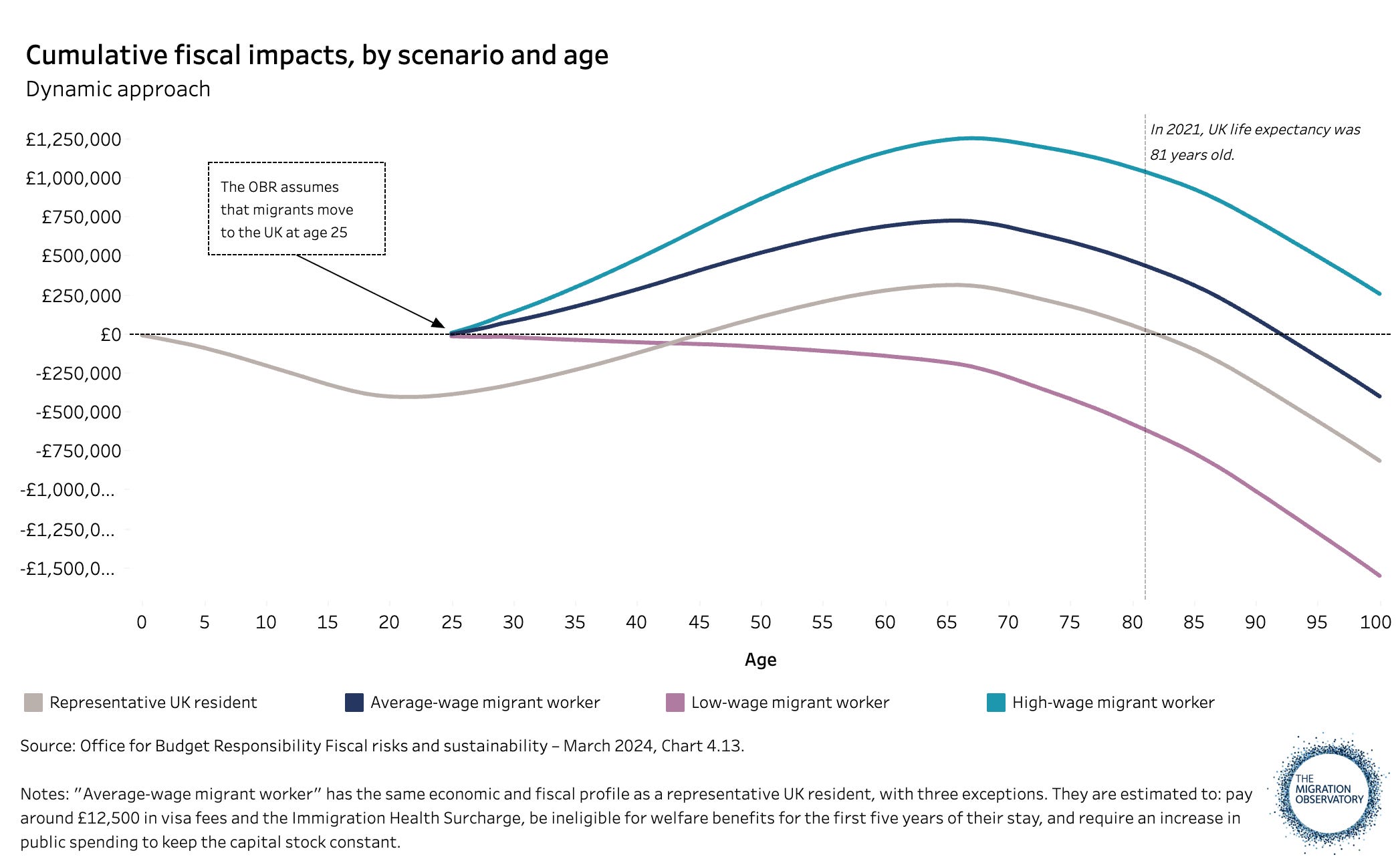
The fact though is that the kind of migrants that the UK attracts are disproportionally working age, skilled and generally filling gaps that society needs to function.
The OBR’s figures largely back this - according to modelling done in 2024, migration was modelled at net 350,000, and it estimated that by 2028/29 (which feels right around the corner), those additional migrants would generate roughly £6.2bn in general taxation while needing significantly lower welfare expenditure because most new migrants do not have recourse to public funds. In terms of borrowing, the central modelling showed a reduction of £7.4bn in borrowing - and even when it modelled the additional costs of maintaining public services per head, higher migration still improved the fiscal position for the country.
On top of general taxation all non-EU settlement also pay a fair whack to move to the UK, generally made up of around £1,900 in visa fees and around £2,600 on the Immigration Health Surcharge, with the total revenues from these sources coming in at around £4.1bn a year.
These are not insignificant numbers.
Now, I can already hear people mentioning those “legitimate concerns” that I mentioned earlier - and there are issues that people are worried about. Not being able to find a GP appointment, rent costs going up, no available places in schooling, their town having changed remarkably quickly, their wages not having gone up in years.
Those are, without a doubt, legitimate concerns - but crucially, a legitimate concern should always be the beginning of an investigation, not the end of one. If someone goes to a doctor and tells them they’re short of breath, said doctor doesn’t say “yes, that’s certainly a legitimate concern, you must have tuberculosis” - they start figuring out the why.
And the why is complex, being made up of years of neglect to our public services, a lack of training of the people who actually live in this country, Austerity and, of course, the big elephant in the room - Brexit.
If this were all concentrated in the far-right of politics, it would still be bad, but at least expected - but it didn’t stay there.
The Labour government, when it came into power, immediately jumped onto the “legitimate concerns” bandwagon and set about dropping migration numbers as hard as they possibly could - and this is the one place where they have unfortunately been extremely successful.
The latest ONS estimates put net migration for the year ending December 2025 at 171,000 - almost half of what it was for 2024 at 331,000. Work related non-EU migration fell by 47% in a single year.
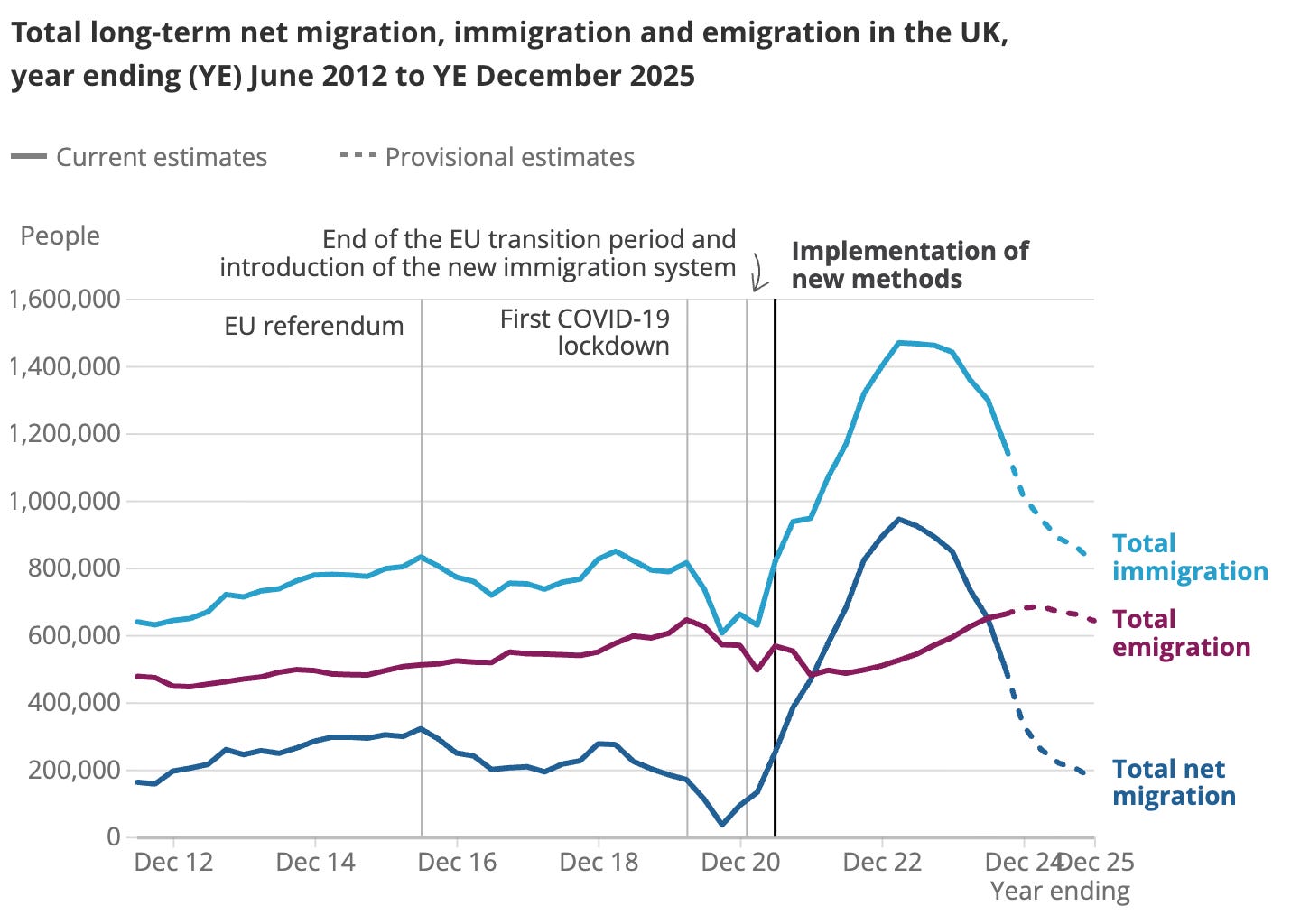
The most dystopian thing about that though has been the Labour government desperately taking this achievement to anti-migrant voters that they appear to be courting, and each of them looking vaguely at the numbers and responding with “but that’s not enough, there’s still too many of them!”
They have also not stopped since then - their immigration white paper is looking at pushing migration numbers down even further, and it explicitly states that “net migration must come down.” It’s a bloody chapter heading, they’re that serious about it - which is perhaps unsurprising considering Starmer himself described the damage done by the previous government’s levels of migration as “incalculable”.
Anyone telling me that Labour has adopted a migration-positive, or even particularly migration-neutral, stance seriously needs to get their eyes checked.
Before people come at me on the white paper - yes, I read it in full, and yes, there are absolutely some sensible things in there.
I agree that employers shouldn’t be allowed to suppress wages indefinitely by recruiting internationally. Yes, the UK should be training far more nurses, careworkers, engineers and trade people. Exploitative sponsorship arrangements absolutely should be stamped out.
The issue I have is that none of those things logically requires “therefore net migration must come down”.
I have been vocal about my disappointment in the Labour Party since they came into power - but I will say they are not the only group that have been pressured into self-sabotage by the right-wing in this country. David Cameron folded like a cheap camping chair to the demands of UKIP and their ilk by calling for a Brexit Referendum.
He, for some reason, accepted the right-wing framing that Europe was the problem facing the country, therefore we must prove we are tougher on Europe - and when his negotiations didn’t work, the ultimate direction of travel was that ill-fated referendum.
For Starmer and co, it was accepting that immigration was the problem, therefore we must obviously be tougher on immigration and migrants, therefore numbers will fall.
And fall they did. Now comes the invoice for that fall - just added to all the Brexit bills that keep piling up.
If you note some frustration in this post - you’re not wrong. I am frustrated that so much policy making in this country has been dictated by the far-right. I am frustrated that the government keeps getting told that they’re going to shoot themselves in the foot before proceeding to aim a bit more carefully at their big toe.
The far-right really is brilliant at exposing problems - what they have never been good at is actually figuring out what caused things.
This is where the argument completely fails:
We have been told time and time again that fewer migrants would mean less pressure on our economy - just for the Chancellor to be handed yet another multi-billion pound bill because of that fall in migration.
The “legitimate concerns” were real, but the diagnosis was wrong - and instead of fixing housing, training, wages and public services, government chose to hammer migration because the far-right told them that was the problem.
We have done this before with Brexit, and once again the country is being left to pick up the tab.
Spot on as usual Bear. On the basis that MPs are generally speaking rank amateurs when regarding them being suitable for getting the job we give them, when they get into government and are given a cabinet position, they are still those rank amateurs. They are guided by the Party, and also by the Civil Servants, the Heads of the various departments, and although these people are allegedly politically neutral, the institutions they are recruited from are certainly not, and in my opinion that is why so little has changed with Labour getting into office - Sir Humphrey is still there getting on with his own career and his handlers wishes.
Another piece of top quality, accessible commentary from the Bear .. thank you bear I understand better this major issue of the moment