

Editor Note:
At a time when the headlines are dominated by war, crisis, and increasingly ominous economic signals, it feels both necessary and human to occasionally step outside that cycle. One of my goals this year was to give more writers a platform here, and Claire has very quickly proven herself to be one of the most compelling additions. I hope you enjoy this read as much as I did, and if you have any ideas of your own, please feel free to email them to iratusursusmajor@gmail.com
The ‘music festival day 3’ state of Luton airport’s toilets doesn’t help the mental state of the nervous flyer. An unwanted thought snakes into my head that maybe they treat their aircraft maintenance with similar neglect. But I down the Propranolol anyway, prescribed, in my case, to control racing heartbeats triggered by even the slightest turbulence. With gritted fatalism I then press on to the departure gate.
Before anyone concludes that nervous flyers simply lack a basic grounding in aeronautical science, be assured that we do understand how 2 pods dangling under each wing of an Easy Jet Airbus A320 suck in enough air to support around 180 people and keep 80,000kg of metal suspended at 30,000 feet above the earth, pulling the craft forward at 550mph. We get all this. But, as any religious person will tell you, there is more to human experience than science; and as any psychologist will tell you, humans can entertain entirely contradictory perceptions simultaneously.
My own fear of flying has an additional layer of complexity I’ve no idea if others share. It has a flip side – a stubbornly Peter Panish state of intense awe and wonder that neither adulthood nor familiarity has succeeded in crushing. The philosopher Emmanuel Kant correctly spotted a link between awe and fear, but they make odd bedfellows in the nervous flyer’s head.
Falling
I was fortunate to have parents who took me on regular flights around the world. So, unfamiliarity isn’t the problem. In those days planes fell from the sky with alarming regularity. But it was also the time of the mighty BOAC VC10. Riding the later fat-bellied Jumbo Jets, we would hold our breath, willing them to stay up as they staggered unconvincingly into the thin air above Nairobi airport.
By contrast, the VC10, with its sleek, futuristic body and ‘go faster’ tail fin, took off with masterful authority like a rocket. Whatever its fate in the sky, there was no doubt about its determination to get there. Sadly, the racket made by this fuel-guzzling beast meant it had to be withdrawn. But I miss the reassuring confidence of its take-off performance.
Back in the present, as I pass the departure gate staff, I scrutinise them for any signs of controlled alarm we might share. But there’s nothing. Their workaday ennui only emphasises my own silent trepidation as I walk the final leg from safety to uncertainty through that ‘point of no return’ Nasa corridor clamped to the side of the craft.
Juddering
Even before take-off, the peculiar emotional conflict between terror and awe kicks in, and I arm-wrestle an urge to remind everyone present of the gravitas of our circumstances. As the plane creeps deceptively slowly to the take-off runway, the body of the cabin creaks and judders, a disconcerting reminder of the essential physicality of our situation and what’s about to happen. Knuckles clench.
Once positioned, with an announcing roar, the plane leaps forward. As it tears along the tarmac, the velocity pins us into our seats and the cabin contents begin rattling violently. It’s reminiscent of those news clips of astronauts during rocket launch when the crescendo of juddering seems about to shake the cockpit to pieces.
As we and the cabin also vibrate under the strain of the plane’s take-off efforts, I glance at the other passengers, convinced they must share my acute existential tension. But the guy next to me is playing Candy Crush, the woman across the aisle is doing her makeup, and the bloke next to her is sorting his paperwork. As far as they’re concerned, they could be on a bus from Tooting to Islington or a routine train ride in all its unexceptional ordinariness. Once again, I’m baffled and alone in my headspace of mortal terror.
Gliding
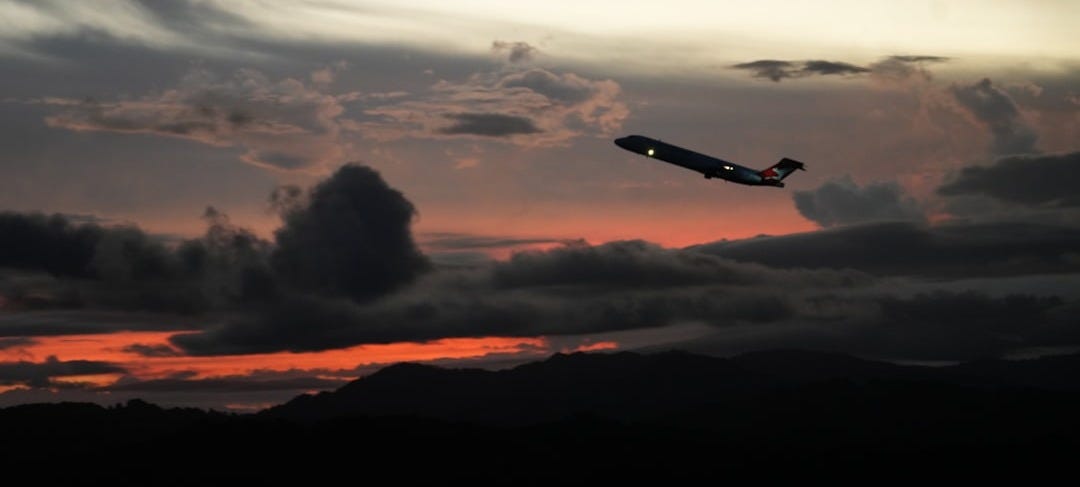
I resist the urge to shout at them as the plane plunges on. But as it reaches maximum judder, suddenly we leap away from the earth, the excruciating shaking replaced, like an orchestral mood change from agitato to pacato, with a serene upward glide. It’s like reaching outer orbit or the gates of heaven. I look around again but the passengers are unperturbed. The ground falls away and, with it, perhaps mercifully, Luton airport. The busy ribbon of the M1 rapidly shrinks to a thinning string across the miniaturizing landscape.
As we cross the M1 I recall something from my strange archive of flying sensations – I remember, whilst driving past Heathrow, experiencing chronic FOMO as huge metal birds with their human cargo destined for faraway places swooped across the M25 just above our heads, alarmingly massive in their proximity. From the safe gridlock of motorway traffic, I felt nothing but envy. And now I’m struck by the thrill that this time it’s our metal bird that could be the FOMO object for some wretched soul landlocked below on Blighty’s first motorway.
Bouncing
But then the yo-yo’ing begins. The plane’s serene upward glide is suddenly replaced by bouncing as it pursues a new less certain ascent into the clouds. The movement reminds my heart that I’m in a glorified metal toothpaste tube and the Propranolol needs to do its work. For anxious flyers the racing heart is a reflex response which bypasses all higher cognitive functions.
Believe me, I’ve tried thinking my way out of it. How many times have I closed my eyes and pretended I’m simply driving on a bumpy road? The sensations are frankly identical. But the heart will not have it. The heart knows we are bouncing in space with 30,000 feet of nothingness below us, not a road. Remember that game you played when you fall backwards and your friend catches you? Recall that split second as you fell when your gut was grabbed by a sense of vertiginous helplessness. Now imagine that feeling (agonisingly) triggered by the plane’s every movement during flight. It’s exhausting and why I avoid flying for more than my endurance limit of two hours.
Cruising
After bouncing upwards, planes tend to aim for a level where they can cruise more serenely. This search often leads them to an elevation where the sun always shines above an unbroken, billowing duvet of clouds. To oddballs like me, despite the anxiety, this arial, snowy world is unfailingly extraordinary, astoundingly magnificent.
But during this trip, we enter an even more spectacular world - a 3-D cloud mountain range where cumulonimbus pillars tower behind rolling cumulus hills. Smoky foreground shapes skirt huge distant peaks, unearthly white in brilliant sunlight, and persuasively solid.
I tense absurdly as our metal bird aims straight at the wall of one of these celestial masses and dives into its belly. Inside it is sunless, foggy and confused and we start bouncing again. But we escape, bursting back out into the blue air and, like a mountain eagle, glide on, dwarfed by the cloud mountains whose sides we traverse.
I glance around at my fellow passengers again. I’ve given the nearer ones names now – I feel this is important in case we crash in the jungle, survive, and decisions have to be made about who eats who. Frank has switched from Candy Crush to GTA, Janice is now asleep and Ron is still checking his papers. Should I draw their attention to the fantastical world we’re in? Perhaps they’d share my wonder if they could only look.
But I’m doubtful. Instead, I sharpen my jungle plans whilst pondering whether it’s actually imagination that prevents familiarity from deadening sensibility. Even during these elevated thoughts, the over-excited child in me wants to grab Frank, Janice and Ron by the ears and jam their eyeballs up against the windows. But I refrain.
Descending
The only advantage of the descent over the ascent is the prospect that the flight will soon end. Despite the arial thrills, my heart craves the safety of terra firma. We begin to sway perilously, zigzagging downwards, as tiny cubes and scribbles below transform into office blocks and roads.
The final moment arrives as we near the runway and the ground rushes up to meet us. We are so close to it now, the actual speed at which we are travelling suddenly becomes acutely apparent. At the same time, we are now falling so fast that crashing into the ground seems virtually unavoidable. I involuntarily brace, grabbing the sides of the seat in front in a futile attempt to absorb the dreaded moment of impact. And it comes. The rubber tyres of this massive metal beast slam into the tarmac and we bounce once more, this time heavily against real ground.
Landing
It’s not until the nervous flyer touches down and, flooded with relief neurotransmitter, punches the air with the gratitude of Buzz Aldrin or a shipwrecked sailor washed ashore, that they recognize the extent to which they’ve spent the last few hours ruthlessly micromanaging their core terror.
In this moment of giddy euphoria another concern strikes. Might the pilots, now reconstructed as valorous saviours, feel demoralised by the blithe indifference of passengers to their heroism in guiding us all through space at 550 mph 30,000 feet up? The prospect of Frank, Janice and Ron shuffling past with the token nod you’d give a bus driver feels intolerable to my euphoria-addled mind. To ensure our heroes are properly congratulated, I’m obliged to tell them myself. They look startled, then grin bashfully as we share a secret moment of knowing rapport.
The passengers hurry away, but I linger, glancing back to wonder at this huge,brooding metal bird now perched on the tarmac, its surprisingly small cockpit eyes peering above its great nose as its whirring engines wind down. There’s even a little grief, a dragging moment of loss, at parting. And sorrow that the ordinariness of flying means the powerful experiences this paradoxical, magical beast evokes are lost on 99% of its users.
I love this piece. I am fortunate to marvel at the wonder of flight without the terror. The cloudscapes, physics and power. I particularly love trying to identify places on the ground, six miles down.
A very memorable return from Ibiza to Manchester when one was able to see the Straits of Dover, the ship wakes and both portals of the Channel Tunnel all lit by the setting sun.
I also marvel at pilots who bring us down safely in Manchester, where they can see nowt but cloud. Maybe a glimpse of Audenshaw Reservoirs or the Pyramid in Stockport.
This piece absolutely describes how I feel every time I fly. Here’s me thinking I’m the only one! Thank you