A Big Old Homosexual’s Growing Sense of Dread
The UK still calls itself progressive on LGBTQ rights, but the data, and the mood, tell a more complicated story.
There is something that, over the past few years, has become a bit of a niggle in the back of my mind. A niggle that’s been recently getting just a little bit more insistent.
Many of you will know that I am a big old homosexual. I say this quite literally. I am a 6ft3, broad-shouldered, actual physical BIG homosexual. I’ve been with my husband for the past sixteen years, married for ten of them, and I would absolutely say that I’m a proud member of the LGBTQ community.
The niggle I opened up with, though, is the fact that the world has been feeling less… safe.
In the UK, I haven’t felt it to be overt to myself in particular. I am not walking down my local high street clutching my pearls and expecting the local Waitrose queue to turn into a militia, however, I can’t help having the sense that there is a narrowing happening. A slow but steady closing-in of walls that is becoming harder and harder to ignore.
It has, most obviously and pretty blatantly, started with my trans friends.
There isn’t a week that’s gone by over the past several years without some sort of panic about trans people, coming either from the media, a right-wing political party or, more often than not, from beloved children’s authors who made billions writing about the importance of love, courage and resisting authoritarian cruelty before apparently deciding the real danger was someone using the loo in peace.
And before anyone starts, I know how this conversation now tends to go - somebody will immediately insist that this is all very reasonable.
That it is only about “safeguarding”, “clarity” and “women’s spaces”.
That nobody is attacking trans people per se, everyone is simply asking questions, endlessly, forever, until the questions themselves become a policy regime.
That, however, is not how it feels from inside the community.
From inside, it feels like watching one group of people be slowly separated from the rest of us and marked out as a group acceptable to target. The jokes become normal. The headlines become normal, language hardens and suddenly, politicians follow. Institutions adjust, and the public learns that this particular minority is now up for debate.
To anyone with even a passing knowledge of LGBTQ history there would be an understanding of just why this makes us as a community nervous, because it never stays with one group.
The moral panic machine that gets rolled out so often these days needs one thing above all - fuel. Once it has finished with trans people, it will not politely pack itself away, thank everyone for their time and return to the shed. It will look for the next target. The next “concern”. The next group whose existence can be reframed as suspicious, excessive, fraudulent, dangerous or somehow incompatible with “ordinary people”.
The Section 28 vibes are not imaginary, nor are they hysterical, because that particular piece of legislation from the eighties didn’t arrive with a cartoon villain twirling a moustache and announcing that queer people were to be punished for the sport of it. It arrived through the language of protection. Children had to be protected. Families had to be protected. Society had to be protected from “promotion”.
There is always a protective wrapper around this stuff.
That is part of what makes it work.
And now, in 2026, the data is starting to tell the same story many of us have been feeling in our bones.
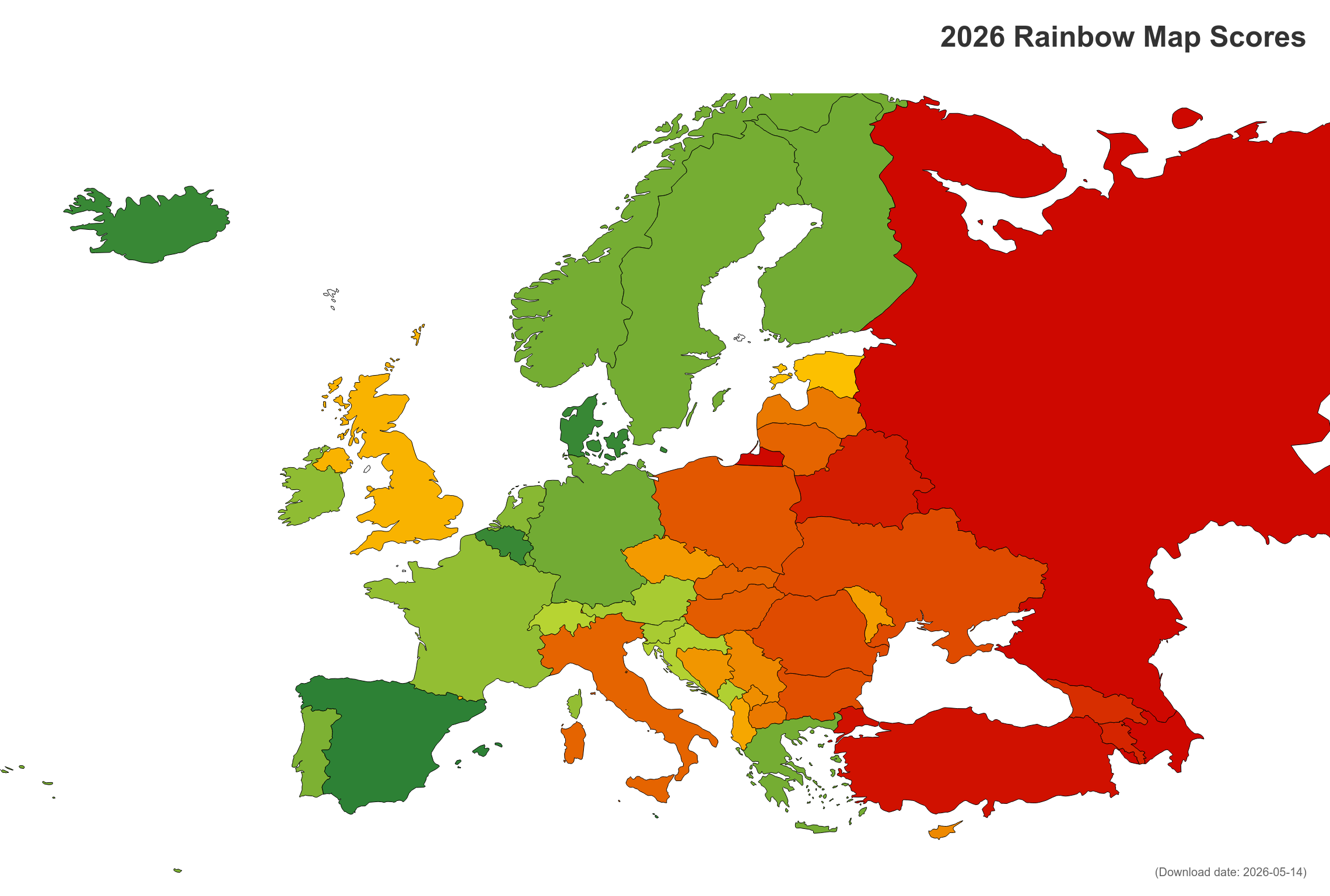
The UK’s overall score on ILGA-Europe’s Rainbow Map published this week, has fallen sharply over the past decade. In 2015, the UK scored 86%, the high watermark for the country, but by this year, that had dropped to 43.9%, placing it only just above the European average of 42.73% and below the EU average of 52.10% - a sustained collapse in standing that in most areas of life would leave people rather concerned.
The category scores are even more worrying to me. The UK scores 49.13% on equality and non-discrimination, 40.55% on hate crime and hate speech, 16.67% on asylum, 6.57% on legal gender recognition and 0% on intersex bodily integrity.
The country still scores strongly on civil society space, which is good, but it also means we are in the grimly British position of being allowed to organise politely while the foundations underneath us are being chipped away.
Very democratic. Very laminated. Very “please fill in this consultation while your rights are being reinterpreted and slowly eroded”.
The legal gender recognition score is particularly bleak. ILGA-Europe records the UK at 6.57% in this category, and its UK recommendations include ensuring accessible trans-specific healthcare, addressing excessive waiting times, restoring access to puberty blockers outside restrictive research frameworks, ensuring effective legal gender recognition after the For Women Scotland judgment, and banning conversion practices on the grounds of sexual orientation and gender identity.
In April 2025, the UK Supreme Court ruled that, for the purposes of the Equality Act 2010, “sex” means biological sex, and that obtaining a Gender Recognition Certificate does not change a person’s legal sex for Equality Act purposes. The court stressed that trans people remain protected from discrimination under the protected characteristic of gender reassignment, but the practical implications have been profound and are still rippling through public services, workplaces, policing, sport and single-sex spaces.
For many trans people, this has not felt like a tidy legal clarification that provides, but rather more like being told that the recognition they fought for over many decades can be made conditional at the drop of a gavel, partial and functionally hollow whenever the state decides another definition is more convenient.
And when you see that happening to people you care about, you start asking a pretty logical question:
If they can do that to them, why would I assume they will not eventually do something to me?
Which is where my growing anxiety lives. Neither in bunker nor paranoia. Not even in a fever dream where I imagine the rainbow police turning up at my door with a clipboard and a badly designed lanyard.
It lives in pattern recognition.
It lives in watching how people who once called themselves allies decided very quickly that trans people were too complicated, too politically inconvenient, too much of a liability. It lives in watching institutions bend under pressure from bad-faith campaigners. It lives in seeing politicians calculate that throwing one part of the LGBTQ community under the bus might buy them a few minutes of peace from the tabloids.
And it lives in the knowledge that the bus never stops with one passenger.
Last month, we were all treated to headlines from a BBC investigation reporting that some people seeking asylum had allegedly been helped to pretend to be gay in order to strengthen asylum claims. Downing Street responded by saying fraudulent claimants would face deportation and criminal referrals, and Shabana Mahmood warned that lawyers enabling these scams could face prison and asset seizures.
My heart went cold when I read it. Not because fraud should be ignored, obviously it shouldn’t - if people are exploiting asylum processes, that needs to be dealt with properly - but because I know exactly how this story can be weaponised.
It starts with “some asylum seekers are pretending to be gay”.
Then it becomes “how do we know who is really gay?”
Then it becomes “are gay asylum claims being abused?”
Then “are LGBTQ protections a loophole?”
Then “are LGBTQ identities being used to manipulate the system?”
Then, before you know it, my husband and I are no longer just two middle-aged gays trying to get through the week, pay the mortgage and decide whether we can be arsed to cook or should just order Lebanese again. We become part of a suspicious category. That is how these narratives move.
They rarely start by attacking everyone at once. They begin with the most vulnerable and marginal edge of a community. Asylum seekers. Trans people. Queer migrants. People whose lives are already difficult to defend in the court of public sympathy because the right has spent years making them sound alien, threatening or absurd - and then it spreads. Insidiously, and slowly, but eventually, it starts nipping at your heels.
I worry, genuinely, about the day Reform or another right-wing party starts putting people like me directly in the crosshairs. I worry because I have seen how many people have turned on trans people over the past few years. I worry because the public conversation can change with frightening speed once the right combination of media panic, political cowardice and social media amplification kicks in.
I have been writing online for years. I have received plenty of threats. Most are stupid, performative little bursts of keyboard masculinity from men whose avatars suggest they have strong opinions about both masculinity and air fryers.
There have, however, been two occasions where the threats became serious enough that I was genuinely worried.
One was after I wrote about the constant vilification of trans people.
The other was after I wrote about how abhorrent I find the anti-surrogacy movement.
That tells me where the live wires are - which issues make certain people feel licensed to become vicious. It tells me that family, gender, reproduction and queer identity remain deeply combustible subjects in this country, no matter how many rainbow lanyards corporations wheel out every June.
Which is also where a further anxiety has been creeping in, and it’s very specifically about the Labour government in its current form - because I am not 100% convinced that, push comes to shove, my rights will necessary be protected if they ever came under assault.
I honestly, wish I were, but having watched just how easily they have turned their backs on trans people, I’m just not convinced.
I have noted the triangulation, the silences, the capitulations under the auspices of pragmatism. It feels like the same political instinct on immigration that seems to be the government’s modus operandi - move right, sound tough, concede the framing, hope the beast stops feeding and becomes finally sated.
The beast, however, never does, and it’s utterly naive to believe it will.
The right-wing press, social media outrage machines and Reform-adjacent ecosystem will set the direction. They will identify the target. They will escalate the rhetoric, and if Labour’s recent behaviour is any guide, the party will not necessarily resist. It may simply calculate how much of the rhetoric it can absorb without looking too obviously cruel. How many voters, really, this will lose them on the left, and do a calculation on what they think they can afford.
That is what frightens me - not necessarily that the UK is suddenly about to become unsafe for every queer person overnight. It does not work like that.
It’s a court judgment here, a guidance change there, a headline about “fake gay asylum seekers”, a politician “just asking questions”, a school avoiding trans-inclusive language, a party deciding that some rights are too politically expensive to defend, a government promising a conversion practices ban, then somehow never quite finding the time, the courage or the wording.
And then one day you look around and realise the country you thought was, at least broadly, moving forward has quietly reversed direction.
I love this country. As of this year, I will have spent a quarter of my life here. I have friends, work, routines, memories and an unreasonable emotional attachment to the specific misery of British weather.
That love, however, does not require denial and right now, I do not feel reassured.
The graphs attached to this piece should serve as a warning. The UK has fallen from being one of Europe’s stronger performers on LGBTQ rights to something far more mediocre, far more fragile and far more vulnerable to political backsliding.
For a big old homosexual who has spent years believing, perhaps naively, that things broadly move forward, that is hard to reconcile.


I share your concerns 🐻, and I worry that this country is turning away from inclusion and towards hatred. Trans people and refugees appear to be the tip of the iceberg as far as the media are concerned. Labour needs to stop pandering to the right and ensure we can all feel safe here.
Somehow hate percolates through political discourse more readily than love. Seems to be the common denominator these days.